📌 Quick Summary
- Digital marketing is promoting products/services online through websites, social media, email, and ads
- It costs 62% less than traditional marketing and reaches 3x more people
- Main channels: SEO, Social Media, Email, Paid Ads, Content Marketing
- Small businesses can start with just $300-500/month
- Expected results: 20-40% revenue growth in the first 6 months
What is Digital Marketing?
Digital marketing is the practice of promoting your business, products, or services using online channels like websites, social media, search engines, email, and mobile apps. Unlike traditional marketing (TV, radio, print), digital marketing allows you to reach specific audiences, track results in real-time, and adjust campaigns instantly.

Think of it this way: when you see an ad on Instagram, get a promotional email from your favorite store, or search Google and find a business—that’s all digital marketing in action.
Why Digital Marketing Matters in 2026
The digital landscape has changed dramatically. Here’s why every business needs digital marketing now:
Cost-effectiveness: Digital marketing costs 62% less than traditional marketing while generating 3 times more leads. A small business can compete with larger companies on a reasonable budget.
Consumer behavior has shifted online: 87% of shoppers begin their product searches online before making a purchase. If you’re not visible digitally, you’re invisible to most potential customers.
Measurable results: Unlike a billboard, where you can’t track who saw it, digital marketing shows you exactly how many people viewed your ad, clicked your link, and made a purchase. Every dollar spent is tracked.
Targeting precision: You can show your ads only to people who match your ideal customer profile—specific age, location, interests, income level, and even online behavior. No more wasted ad spend.
7 Main Types of Digital Marketing
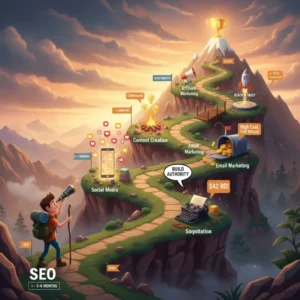
1. Search Engine Optimization (SEO)
SEO is optimizing your website to rank higher on Google search results without paying for ads. When someone searches “best coffee shop in Madurai,” SEO helps your cafe appear on the first page.
How it works: You create quality content, use relevant keywords, build website authority through backlinks, and ensure your site loads fast and works on mobile devices.
Time to see results: 3-6 months for significant traffic growth
Cost: Free to do yourself, or $500-2000/month if you hire an expert
Best for: Long-term sustainable traffic, businesses selling information or services
2. Social Media Marketing
Promoting your business on platforms like Facebook, Instagram, LinkedIn, Twitter, and TikTok. This includes both organic posts (free) and paid advertising.
How it works: You create engaging content that your audience wants to see, interact with followers, run contests, and use platform algorithms to increase your reach.
Time to see results: 1-3 months to build engaged following
Cost: Free for organic content, $5-50/day for paid ads
Best for: B2C businesses, visual brands, building community, customer service
3. Content Marketing
Creating valuable content (blog posts, videos, infographics, podcasts) that attracts and educates your target audience rather than directly pitching products.
How it works: You identify what questions your customers ask, create helpful content answering those questions, and distribute it through various channels. This builds trust and positions you as an expert.
Time to see results: 3-6 months for traffic, 6-12 months for significant leads
Cost: Free if you create content yourself, $100-500/article if outsourced
Best for: Building authority, educating customers, complex products/services
4. Email Marketing
Sending targeted messages directly to people who’ve given you their email addresses. This includes newsletters, promotional offers, product updates, and automated sequences.
How it works: You collect emails through website signup forms, create segments based on customer behavior, and send personalized messages that drive sales or engagement.
Time to see results: Immediate for existing lists, 3-6 months to build a quality list
Cost: Free up to 500-2000 subscribers (Mailchimp, MailerLite), then $10-100/month
Best for: Highest ROI channel (average $42 return per $1 spent), repeat purchases, customer retention
5. Pay-Per-Click Advertising (PPC)
Paying for ads on search engines (Google Ads) or social platforms (Facebook Ads), where you only pay when someone clicks your ad.
How it works: You bid on keywords or target specific audiences, create compelling ads, and send traffic to optimized landing pages. You set daily budgets and can stop anytime.
Time to see results: Immediate (within hours of launching)
Cost: Minimum $10-20/day, average small business spends $500-3000/month
Best for: Quick results, product launches, time-sensitive promotions, high-value services
6. Affiliate Marketing
Partnering with other people or companies who promote your products in exchange for a commission on sales they generate. Alternatively, you can promote other companies’ products and earn commissions.
How it works: You provide affiliates with unique tracking links. When someone clicks their link and makes a purchase, the affiliate earns a percentage (typically 5-30% of the sale price).
Time to see results: 1-3 months to recruit and onboard affiliates
Cost: Free to start, you only pay commissions on actual sales
Best for: E-commerce, digital products, businesses with good profit margins
7. Influencer Marketing
Collaborating with social media influencers who have engaged audiences that match your target market. They create content featuring your product/service and share it with their followers.
How it works: You identify influencers whose audience matches your ideal customer, negotiate partnership terms, and they create authentic content showcasing your brand.
Time to see results: Immediate engagement, 1-2 weeks for conversions
Cost: Nano-influencers (1k-10k followers): $10-100 per post, Micro-influencers (10k-100k): $100-500 per post
Best for: Fashion, beauty, lifestyle, tech products, B2C brands targeting younger demographics
How to Start Digital Marketing: 5 Simple Steps
Step 1: Define Your Goals
Before spending any money, get crystal clear on what you want to achieve. Common goals include:
- Increase website traffic by 50% in 3 months
- Generate 20 qualified leads per month
- Boost online sales by 30% in 6 months
- Grow email list to 5,000 subscribers
- Improve brand awareness in your local area
Write down specific, measurable goals with deadlines. “Get more customers” is too vague. “Generate 30 leads per month at under $20 per lead” is actionable.
Step 2: Know Your Audience
Create a detailed profile of your ideal customer. Include:
- Demographics: Age, gender, location, income, education, job title
- Psychographics: Interests, values, lifestyle, pain points, goals
- Online behavior: Which platforms they use, when they’re online, what content they engage with
- Buying behavior: How they research products, what influences their decisions
Example: “Priya, 32, marketing manager in Bangalore, earns ₹8 lakhs/year, active on LinkedIn and Instagram, struggles with time management, values quality over price, researches thoroughly before buying.”
Step 3: Choose Your Channels (Start with 2-3)
Don’t try to be everywhere at once. Pick channels based on where your audience spends time and your budget:
Limited budget ($300-500/month):
- Primary: SEO + Content Marketing (blog posts)
- Secondary: One social media platform (Instagram or LinkedIn)
- Tertiary: Email marketing (free up to 500 subscribers)
Medium budget ($1000-3000/month):
- Primary: SEO + Google Ads
- Secondary: Facebook/Instagram Ads
- Tertiary: Email Marketing + Content Marketing
Larger budget ($5000+/month):
- All of the above, plus influencer partnerships, video marketing, and advanced automation
Step 4: Create Your Content Calendar
Plan what you’ll post and when. Consistency beats perfection.
Minimum viable schedule:
- Blog posts: 2-4 per month (8-12 per month ideal)
- Social media: 3-5 posts per week
- Email newsletter: 1-2 per month (weekly is better)
- Video content: 1-2 per month if possible
Use free tools like Google Sheets or Trello to plan content 30 days ahead. Batch-create content in dedicated work sessions rather than scrambling daily.
Step 5: Measure and Optimize
Track these key metrics monthly:
Website traffic:
- Total visitors
- Traffic sources (organic, social, direct, referral)
- Bounce rate (should be under 60%)
- Average time on page (aim for 2+ minutes)
Engagement:
- Social media followers growth
- Email open rate (aim for 20-30%)
- Click-through rate (aim for 2-5%)
- Comments and shares
Conversions:
- Leads generated
- Cost per lead
- Conversion rate (website visitors who take action)
- Revenue generated
Use Google Analytics (free) to track website metrics and platform-specific analytics for social media and email. Review data monthly and adjust what’s not working.
Digital Marketing Strategy Example for Small Business
Let’s say you run a boutique fitness studio in Chennai targeting young professionals.
Month 1-2: Foundation
- Create Google My Business listing (free, local SEO)
- Build a simple website with a class schedule and booking ($100)
- Start Instagram account posting 4x/week: workout tips, client transformations, behind-the-scenes
- Collect emails at the studio with the “Free 7-Day Meal Plan” offer
- Budget: $100-200
Month 3-4: Growth
- Launch Facebook Ads targeting 25-40 year olds within 5km radius ($20/day = $600/month)
- Offer: “First Class Free + 20% Off First Month”
- Send weekly email tips to the collected emails
- Post 2 blog articles/month: “Best Workouts for Desk Workers,” “How to Stay Fit with a Busy Schedule.”
- Budget: $700-800/month
Month 5-6: Scale
- Continue ads, increase budget to successful campaigns
- Partner with local health influencers (1-2 posts/month)
- Create a referral program (existing members get ₹500 credit for referrals)
- Add Google Ads targeting local fitness-related searches
- Launch a YouTube channel with 10-minute workout videos
- Budget: $1000-1500/month
Expected results after 6 months:
- 50-100 new inquiries per month
- 20-30 new memberships per month
- 80-90% of new members cite “found online” as discovery source
- Email list of 500+ engaged subscribers
Common Digital Marketing Mistakes to Avoid
Mistake 1: Trying to be on every platform. Focus breeds mastery. Choose 2-3 channels and do them excellently rather than 7 channels poorly.
Mistake 2: No clear offer or call-to-action. Every piece of content should tell people exactly what to do next: “Download free guide,” “Book consultation,” “Shop now.” Don’t make them guess.
Mistake 3: Ignoring mobile users 62% of online traffic comes from mobile devices. If your website isn’t mobile-friendly, you’re losing half your potential customers.
Mistake 4: Not building an email list. Social media platforms can change their algorithms or shut down. Your email list is an asset you own forever. Collect emails from day one.
Mistake 5: Giving up too soon. Digital marketing is not a magic button. SEO takes 3-6 months, and content marketing takes 6-12 months to show significant results. Most businesses quit right before success.
Mistake 6: No tracking or analytics. If you can’t measure it, you can’t improve it. Set up Google Analytics, track conversions, and know your numbers. Data beats opinions.
Digital Marketing Tools You Need (Free Options)
For website and SEO:
- Google Analytics (track website traffic)
- Google Search Console (monitor search performance)
- RankMath or Yoast SEO (WordPress SEO plugin)
- Ubersuggest (keyword research, 3 free searches/day)
For social media:
- Canva (create graphics, free version is excellent)
- Buffer or Later (schedule posts, free up to 10 posts)
- CapCut (edit videos, completely free)
For email marketing:
- MailerLite (free up to 1000 subscribers)
- Mailchimp (free up to 500 subscribers)
- SendGrid (free up to 100 emails/day)
For content creation:
- Grammarly (fix writing errors, free version)
- Hemingway App (improve readability, free)
- AnswerThePublic (find content ideas, 3 free searches/day)
For project management:
- Trello (organize tasks and content calendar, free)
- Google Sheets (plan everything, free)
- Notion (all-in-one workspace, free for personal use)
Frequently Asked Questions
Q: How much does digital marketing cost for a small business?
You can start with $300-500/month covering basic tools and small ad budgets. Most small businesses invest $1000-3000/month once they see results. The beauty of digital marketing is that you can start small and scale as you profit.
Q: Can I do digital marketing myself, or do I need an agency?
You can absolutely do it yourself if you have 10-15 hours per week to dedicate to learning and execution. Hire an agency ($1500-5000/month) when your time is better spent running your business or you need specialized expertise. Freelancers ($500-2000/month) are a middle option.
Q: How long does it take to see results from digital marketing?
Paid ads show results within days. SEO and content marketing take 3-6 months for significant traffic. Email marketing shows ROI within weeks if you have a list. Social media takes 1-3 months to build engagement. Plan for a 6-month commitment minimum.
Q: What’s the difference between digital marketing and social media marketing?
Social media marketing is one component of digital marketing. Digital marketing includes everything online (SEO, email, ads, website, content), while social media marketing specifically focuses on platforms like Facebook, Instagram, LinkedIn, and TikTok.
Q: Which digital marketing channel has the best ROI?
Email marketing consistently shows the highest ROI at $42 return for every $1 spent. However, the “best” channel depends on your business type, audience, and goals. E-commerce often succeeds with paid ads, B2B companies do well with LinkedIn and content marketing, and local businesses thrive with Google My Business and local SEO.
Q: Is digital marketing suitable for all types of businesses?
Yes, every business can benefit from digital marketing, but strategies differ. B2B companies focus on LinkedIn and content marketing. B2C retail businesses use Instagram and Facebook ads. Service businesses rely on Google Ads and local SEO. Even traditional businesses like restaurants and salons need Google My Business and a social media presence.
Q: Do I need a website to start digital marketing?
While a website is highly recommended, you can start without one using social media platforms and Google My Business listing. However, you’ll get better results long-term with a professional website. Basic WordPress sites cost $100-300 to set up or are free using platforms like Wix or WordPress.com.
Q: What skills do I need to learn digital marketing?
Start with fundamentals: basic writing, understanding analytics, learning one ad platform (Google or Facebook), and SEO basics. You don’t need technical skills to begin. Take free courses on Google Digital Garage, HubSpot Academy, or YouTube. Focus on one skill at a time rather than trying to learn everything simultaneously.
Next Steps: Your Digital Marketing Action Plan
This week:
- Set up Google Analytics on your website
- Create or optimize Google My Business listing
- Choose your 2-3 primary marketing channels
- Write down your specific goals with numbers and dates
This month:
- Create content calendar for next 30 days
- Write and publish 2-4 blog posts
- Set up email collection on website
- Start posting consistently on one social platform
Next 3 months:
- Build email list to 100+ subscribers
- Publish 10-15 quality blog posts
- Test small paid ad campaigns ($10-20/day)
- Track all metrics and double down on what works
Within 6 months:
- Achieve measurable traffic growth (50-100%+)
- Generate consistent leads weekly
- Have documented processes for content creation
- Scale budget to winning channels
Free Resources to Learn More
Courses (completely free):
- Google Digital Garage: Fundamentals of Digital Marketing
- HubSpot Academy: Inbound Marketing, Content Marketing, Social Media
- Meta Blueprint: Facebook and Instagram advertising
- Google Skillshop: Google Ads certification
Blogs to follow:
- Neil Patel (neilpatel.com/blog) – SEO and traffic strategies
- Backlinko (backlinko.com/blog) – Advanced SEO tactics
- Social Media Examiner – Social media best practices
- Copyblogger – Content marketing and copywriting
YouTube channels:
- Neil Patel – Daily marketing tips
- Think Media – Video marketing and YouTube growth
- Vanessa Lau – Social media strategies
- Adam Enfroy – Blog and affiliate marketing
Communities:
- r/digital_marketing (Reddit)
- r/SEO (Reddit)
- Digital Marketing Questions (Facebook group)
- GrowthHackers.com (online community)
Conclusion
Digital marketing isn’t optional anymore—it’s how modern businesses grow. The good news? You don’t need a huge budget or technical expertise to start. Pick 2-3 channels that match where your customers spend time, create valuable content consistently, and track your results.
Start small, learn as you go, and scale what works. The businesses winning online in 2025 aren’t necessarily the ones with the biggest budgets—they’re the ones who showed up consistently, provided value, and adapted based on data.
Your first step is the simplest: choose one tactic from this guide and implement it this week. Whether it’s setting up Google Analytics, writing your first blog post, or creating a social media account, just start. Momentum builds with action.