
Quick Summary
- Set clear goals and understand who your audience is.
- Pick 1–2 platforms that fit your content style.
- Use content pillars to stay consistent.
- Plan posts with a content calendar.
- Use WordPress plugins to share content automatically.
- Track results and improve based on performance.
Starting your journey into digital marketing can feel overwhelming, especially when the online space is crowded with countless guides, tools, and techniques. But even with all this noise, one thing remains constant: a solid Social Media Marketing Strategy is the foundation of any successful digital presence. Whether you’re a student, a blogger, a small business owner, or someone exploring digital marketing for the first time, having a clear strategy will help you grow consistently and confidently.
A strategy doesn’t have to be complicated. You don’t need advanced tools or years of experience to get started. What you do need is focus, structure, and a goal-oriented mindset. This beginner-friendly blueprint breaks down the essential phases that help you plan, create, and measure your social media efforts effectively.
Once you understand these phases, you’ll be able to build your own strategy that supports both your content and long-term growth.
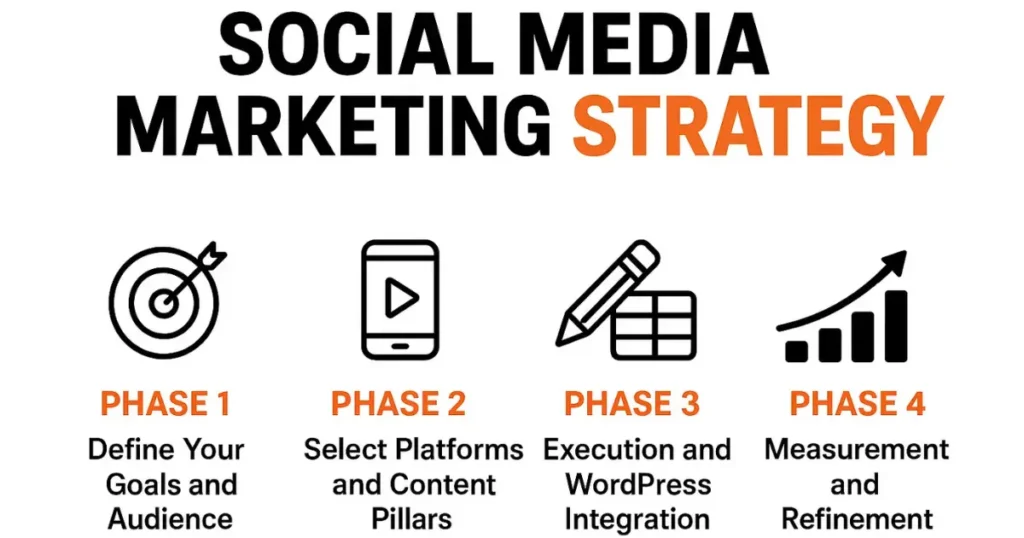
Phase 1: Define Your Goals and Know Your Audience
Every successful Social Media Marketing Strategy starts with clarity. Before you create your first post, ask yourself:
What am I trying to achieve?
Who am I trying to reach?
Set SMART Goals
A powerful approach used by marketers worldwide is the SMART goal system — Specific, Measurable, Achievable, Relevant, and Time-bound. SMART goals give direction and prevent confusion.
Example of a SMART goal:
“Increase website traffic from social media by 15% within the next six months.”
This goal is measurable, time-bound, and specific. You’ll know exactly when you’ve achieved it.
Identify Your Target Audience
Understanding your audience is equally crucial. The more you know about your ideal follower or customer, the better you can create content that truly connects.
Focus on:
- Age, location, and profession
- Interests and challenges
- Their favorite platforms
- Their online activity patterns
- What type of content they interact with
When you know your audience well, your content becomes strategic instead of random.
Phase 2: Choose Your Platforms and Build Content Pillars
Many beginners try to be everywhere — Instagram, LinkedIn, Facebook, X — but a smart strategy is selective. You don’t need to be on every platform; you need to be on the right ones.
Choose 1–2 Primary Platforms
Different platforms serve different purposes:
- Instagram – Visual content & brand personality
- LinkedIn – Professional and educational content
- Facebook – Community building
- X (Twitter) – Short updates and fast engagement
Choose platforms that match your audience behavior and your content style.
Define Content Pillars
Content pillars simplify your posting and ensure consistency. These are the main themes you will focus on.
A balanced content mix:
- 50% Educational content – tips, how-to posts, insights
- 30% Curated content – trusted articles & resources
- 20% Promotional content – products, services, offers
This ratio keeps your feed helpful, trustworthy, and engaging instead of overly sales-focused.
Phase 3: Execution and WordPress Integration
This phase involves planning, creating, scheduling, and managing your content efficiently.
Use a Content Calendar
A content calendar helps you:
- Schedule posts consistently
- Maintain a smooth posting routine
- Plan upcoming topics in advance
- Track what has performed well
A steady posting schedule increases your visibility and helps social media algorithms recognize your activity.

WordPress Support for Social Media
If you publish blogs or manage a website using WordPress, you can directly connect your content to your social platforms. Tools like these make sharing easy and automatic:
- Jetpack Social
- Buffer
- Social Snap
- Revive Old Posts
These plugins allow automatic sharing of your posts the moment they are published. You can also:
- Add social share buttons
- Display social media feeds on your site
- Sync content automatically across platforms
This creates a powerful connection between your website and social media presence, helping your content reach more people instantly.
Phase 4: Analyze Results and Improve Continuously
A good Social Media Marketing Strategy is never static. It grows and improves through regular analysis and refinement.
Track Key Metrics
Almost every platform — Instagram, Facebook, LinkedIn, and X — provides analytics. Focus on these key performance indicators:
- Reach: Number of people who saw your content
- Engagement: Likes, shares, comments, and saves
- Click-Through Rate (CTR): Users who clicked to visit your website
- Follower Growth: How fast your audience is expanding

Refine Your Strategy Based on Insights
Once you start tracking your performance, the next step is improving based on real data. This is where smart growth happens.
- If educational posts perform best, create more of that content.
- If certain platforms aren’t performing, reconsider your focus.
- If your posting time affects engagement, adjust your schedule.
Data-driven decisions speed up your growth and help you clearly understand what your audience truly wants.
Quick FAQ
Looking Ahead
As you continue posting, reviewing, and refining, you’ll discover which content formats, posting times, and platforms work best for you. Over time, this process turns you into a confident digital strategist.
A powerful Social Media Marketing Strategy is never fixed—stay flexible, experiment with new ideas, and grow from your results.