Key Highlights
- An AI search engine uses artificial intelligence, like large language models, to understand your queries in a more human-like way.
- Unlike traditional search engines that match keywords, AI search understands the context and intent behind your questions.
- This technology delivers more personalized and relevant search results by analyzing patterns in your behavior.
- You can use natural language to ask complex questions, as if you were talking to a person.
- AI search can process various data types, making it useful for web searches and business applications.
Introduction
Have you ever felt like your search engine just doesn't get what you're asking? The days of typing rigid keywords are fading, thanks to the rise of the AI search engine. This new technology is revolutionizing how we find information, moving beyond the simple links of a traditional search. Instead of just matching words, AI understands your intent, delivering smarter and more relevant search results. Let’s explore how you can master this new way of searching to get the best answers, faster.

Understanding AI Search in 2024
The AI search engine represents a significant leap forward in search technology. It uses artificial intelligence to deliver a faster and more personalized user experience. Imagine a search tool that doesn’t just scan for words but truly understands the meaning behind your question to provide the most relevant information.
This is the core promise of an AI search engine in 2024. It’s designed to feel more like a conversation, helping you find exactly what you need without the frustration of sifting through irrelevant pages. We will look into what makes this technology different and the core components that power it.
What Makes AI Search Different from Traditional Engines
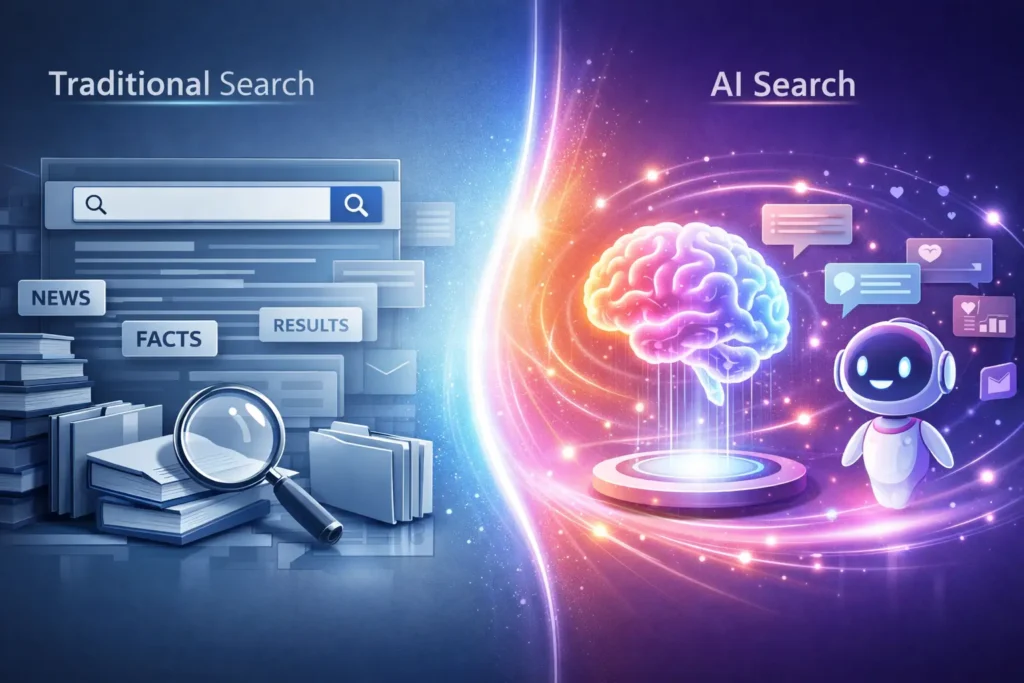
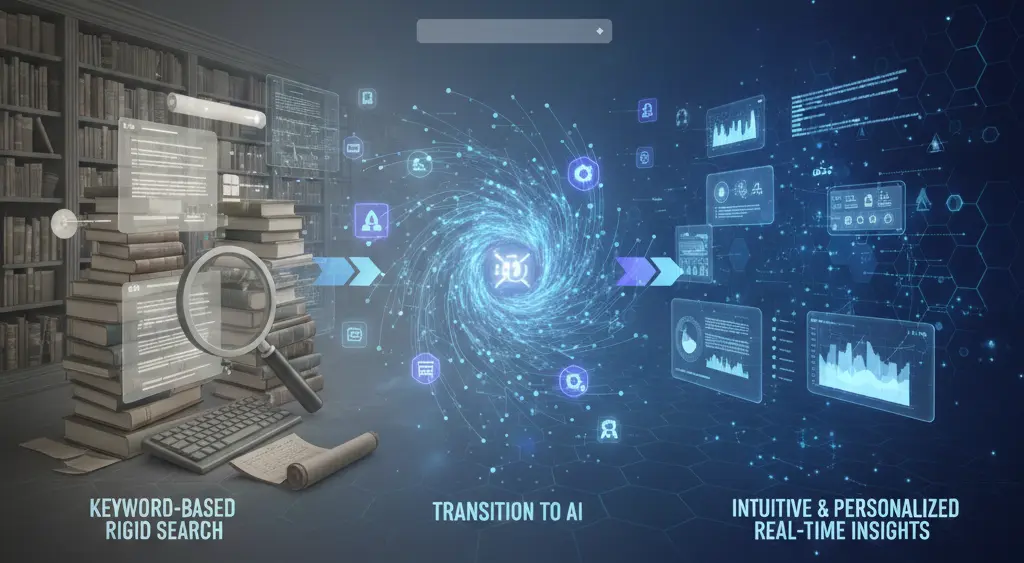
Traditional search engines have served us well by relying on keyword-based indexing. They act like a massive digital library, matching the words in your user queries to the content on billions of web pages. While effective for simple searches, this approach can sometimes provide generic results that don’t quite hit the mark.
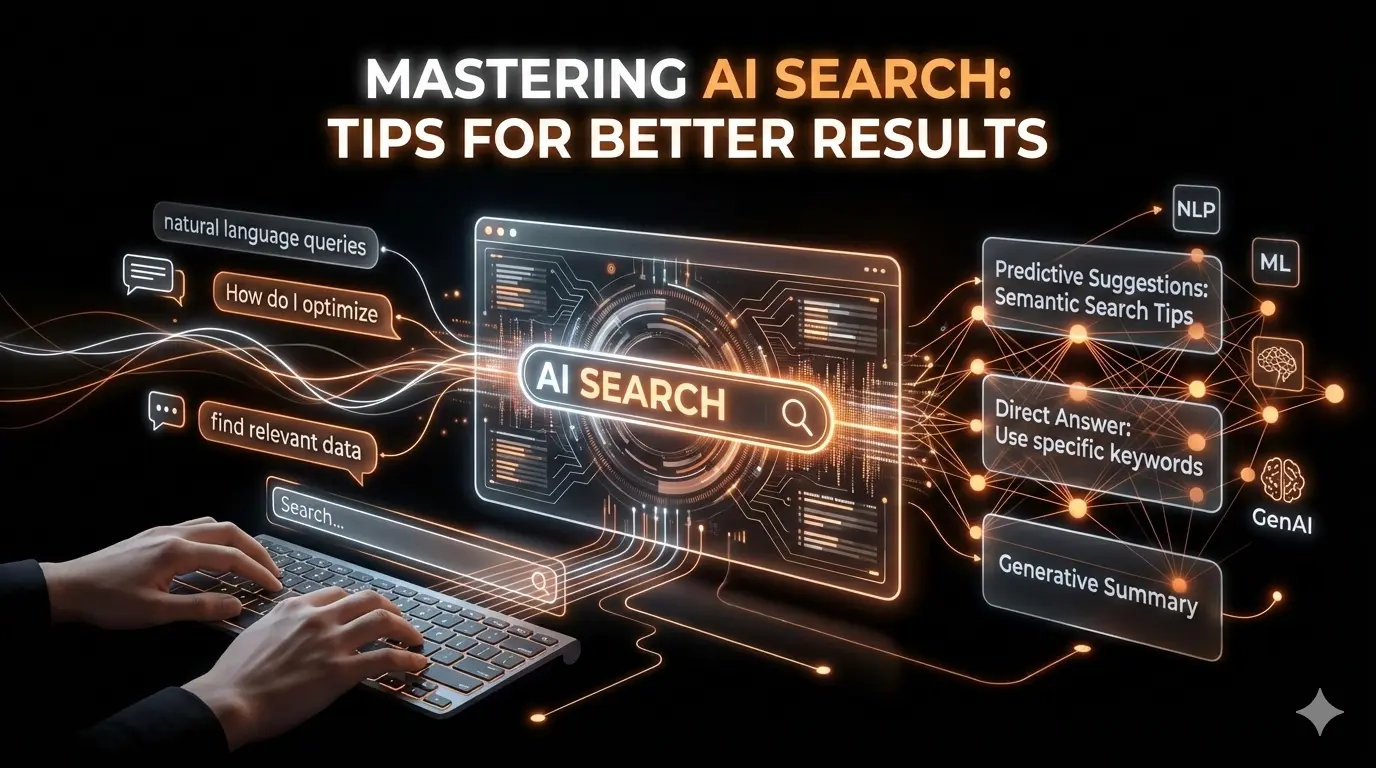
In contrast, an AI search engine functions more like an exceptionally knowledgeable friend. It uses artificial intelligence to understand the context and intent behind your search. Instead of just matching keywords, it deciphers what you truly mean, allowing you to use conversational and natural language. This creates a much more intuitive and user-centered search experience.
This fundamental difference means AI search is proactive, not just reactive. While traditional search engines provide results based on what they’ve already indexed, an AI search engine anticipates your needs and adjusts its responses accordingly. This significant shift helps you get more accurate, personalized answers to even complex queries.
Core Technologies Powering AI Search Engines
The magic behind AI search systems is a blend of powerful artificial intelligence technologies. One of the key drivers is natural language processing (NLP), which gives machines the ability to understand human language. This is what allows you to ask questions conversationally instead of using fragmented keywords.
Another crucial component is machine learning (ML). ML algorithms enable the search engine to learn from data, identify patterns, and improve its results over time without being explicitly programmed. It analyzes user queries and user interactions to continuously refine its understanding of what is relevant, making the system smarter with every search.
Finally, large language models (LLMs), like GPT-4 and Gemini, are the engines that generate coherent and detailed answers. Trained on vast amounts of text, these models can process complete questions, create summaries, and understand the deep context of your queries, which is how search engines like Google are improving their capabilities.

The Evolution of AI Search Capabilities
AI search capabilities have evolved dramatically, moving far beyond simple information retrieval. Early search engines were good at finding documents with specific keywords, but modern AI uses advanced algorithms to understand meaning. This semantic understanding is a major benefit, as it delivers results that are conceptually related to your query, not just textually similar.
One of the most powerful aspects of modern AI search is its capacity for continuous learning. As you and others interact with the system, it analyzes behavior and feedback to refine its performance. This means the search engine gets progressively better at understanding your needs and predicting what you’re looking for next.
This evolution brings us to features like predictive analytics, where the search engine anticipates your needs before you even finish typing. By analyzing past search patterns and real-time data, it can offer instant answers and suggestions. These advanced search capabilities provide a faster, more intuitive, and highly personalized experience compared to traditional search.
How AI Search Engines Work
So, how exactly does an AI search engine find the right answers for you? It all comes down to how it processes information. Instead of just scanning text, an AI search engine uses advanced models to understand the relationships between concepts. It pulls from various data sources, including both structured and unstructured data.
This process allows the engine to grasp the context of your query and deliver truly relevant results. The way an AI search works is fundamentally different, focusing on meaning rather than just words on a page. Let's look at the key technologies that make this sophisticated process possible.
Natural Language Processing and Its Role
Natural language processing (NLP) is at the heart of what makes an AI search engine so effective. This technology bridges the gap between human language and computer understanding. It allows the search engine to interpret your questions when you phrase them in a conversational, natural language style, just as if you were talking to another person.
Instead of relying on a rigid search index based on keywords, NLP helps the engine understand user intent. It analyzes the meaning behind your words, considers the context, and even detects emotional tone in sources like reviews. This allows for a much more nuanced and accurate interpretation of what you are actually looking for.
With NLP, you can move beyond simple keyword searches. You can ask long, complex questions like, "What are some good restaurants near me that have gluten-free options and great reviews?" The system understands each part of that query to deliver a precise answer, making the entire search process more efficient and human-friendly.

Machine Learning in Search Algorithms
Machine learning is a type of AI that helps search algorithms learn and improve on their own. Instead of following a fixed set of rules, these algorithms analyze vast amounts of data to identify patterns. In search, this means the engine learns from every query and interaction to get better at delivering relevant results.
This technology is key to personalizing your search experience. By analyzing user behavior—such as what you click on, what you ignore, and your past search history—machine learning models can tailor results to your specific preferences. This is a big part of how platforms like Google are using AI to make search more intuitive and helpful.
Through this process of continuous learning, the search engine becomes more accurate over time. It refines its understanding of user intent and improves features like autocomplete suggestions and semantic search. Ultimately, machine learning powers a more dynamic and responsive system that adapts to you.

Large Language Models and Generative AI in Search
Large language models (LLMs) and generative AI are transforming search results by providing direct answers instead of just a list of links. AI models like GPT-4 and Gemini are trained on massive datasets, which gives them a deep understanding of language and concepts. This allows them to process your natural language queries and generate fresh, detailed explanations.
When you ask a question like "Why is the sky blue?", a search engine powered by generative AI can synthesize information from multiple sources and present you with a coherent, easy-to-understand summary. This often leads to more accurate and satisfying answers compared to sifting through web pages yourself.
However, it’s important to be aware of their limitations. While these AI models are incredibly powerful, they can sometimes "hallucinate" or provide incorrect information with confidence. Despite this, their ability to synthesize information and answer complex questions directly represents a major step forward in creating more accurate search results.

Top AI Search Platforms and Tools
With the rise of AI, many new search platforms and tools have emerged, each offering unique features. From conversational assistants to enterprise-level search systems, there is an AI search engine for almost every need. Understanding the different options can help you choose the right tool for your specific goals.
Choosing the best platform involves looking at various data points and considering best practices for your use case. Whether you need a tool for personal research or a robust solution for your business, exploring the top players is a great place to start. Let's compare some of the leading services available today.
Google’s Use of AI in Search
Google has deeply integrated AI into its search engine to enhance user experience and the quality of its search results. With features like Gemini (formerly part of its Search Generative Experience), Google now offers AI-generated summaries at the top of the results page. This provides direct, context-rich answers to complex queries.
These AI models help Google move beyond simple keyword matching to better understand the intent behind your search. The system analyzes the relationships between concepts, enabling more effective information retrieval. This means you get answers that are more relevant to what you're actually asking, not just the words you typed.
By incorporating AI, Google can handle nuanced questions, provide follow-up suggestions, and deliver a more conversational experience. This evolution makes the search engine more powerful, helping users find the information they need with less effort and greater precision.

Comparing Perplexity AI, Gemini, and Other Leading Services
When choosing an AI search engine, it's helpful to compare the leading options like Perplexity AI and Google’s Gemini. Perplexity AI is often favored for research-heavy queries and automation workflows, providing detailed, citation-backed answers. It excels at synthesizing information from multiple sources into a comprehensive response.
On the other hand, Gemini is integrated directly into Google Search, aiming to enhance the traditional search experience with AI-generated overviews. It's designed for a broad audience seeking quick, direct answers to everyday questions.
Other notable search systems include You.com, which focuses on customization and privacy, and ChatGPT Search, which blends web search with conversational AI.
Each platform offers a different approach to delivering relevant results. Here is a simple comparison:
| Feature | Perplexity AI | Gemini |
|---|---|---|
| Primary Focus | Research and detailed answers | Integrated web search summaries |
| Best For | In-depth queries, academic use | Quick, everyday questions |
| Cites Sources | Yes, prominently | Often, within the AI overview |
| User Experience | Conversational, answer-focused | Part of the traditional search page |
Exploring Azure AI Search for Businesses
For businesses looking to implement powerful search capabilities within their own applications and websites, Azure AI Search is a leading platform. It is designed to help organizations manage and search through large, decentralized datasets, improving internal knowledge management and customer-facing search experiences.
This platform offers a suite of advanced features tailored for business needs. It combines traditional search methods with modern AI techniques like semantic search and vector search, allowing it to understand the meaning behind user queries, not just keywords. This helps employees and customers find specific information quickly and efficiently.
Some key features of Azure AI Search for business include:
- Semantic Search: Goes beyond keyword matching to understand the intent and context of a query, delivering more relevant results.
- Data Integration: Easily connects to various data sources, allowing you to create a unified search experience across all your business data.
- Customizable Ranking: Lets you tailor the search experience to prioritize the information that matters most to your business goals.
Key Features of Modern AI Search Engines
What truly sets modern AI search engines apart are their sophisticated features. These platforms are powered by advanced algorithms that enable them to understand language, context, and user intent in ways that were previously impossible. They combine different search techniques, like keyword search and vector search, in a method known as hybrid search.
This combination allows an AI search engine to deliver incredibly precise and relevant results. From understanding conversational queries to integrating with other smart technologies, these features are redefining our expectations for search. Let’s explore some of the standout capabilities that make these engines so powerful.
Semantic Understanding and Contextual Awareness
One of the most powerful features of AI search is semantic understanding. This means the engine doesn’t just look at the words in your query; it understands their meaning and the relationships between them. When you search for "apple," it can determine if you mean the fruit, the company, or something else based on the context.
This contextual awareness dramatically improves the search experience. The engine considers factors like your location, past searches, and even the time of day to deliver more personalized and relevant search results. If you search for "best coffee," it knows you're likely looking for cafes near you, not a history of coffee beans.
By understanding the "why" behind your user queries, AI search can provide results that feel tailored specifically to you. This ability to interpret nuance and context enhances your personal intelligence by giving you faster access to the exact information you need, making your search efforts more efficient and effective.
Multimodal and Conversational Search
Modern AI search is no longer limited to just text. With multimodal search, you can use images, voice, and text to find what you're looking for. For example, you could take a picture of a plant and ask the search engine to identify it. This capability allows the system to process different types of unstructured data and provide relevant information.
Additionally, conversational search makes interacting with search engines more natural and intuitive. You can ask follow-up questions and have a dialogue with the AI, which remembers the context of your query. If you ask, "Where is the Eiffel Tower?" and then follow up with "How tall is it?", the engine knows you're still talking about the Eiffel Tower.
This ability to maintain a conversation and understand different data formats makes finding information easier than ever. You can interact with the search engine more like you would with a person, leading to a smoother and more effective search experience.
Integration with AI Assistants and Third-Party Apps
AI search systems are becoming even more powerful through search integration with AI assistants and third-party apps. This seamless connection allows you to access information and complete tasks without switching between different platforms. For example, your voice assistant can use an AI search engine to answer your questions directly.
This integration greatly enhances the user experience by creating a more cohesive digital ecosystem. You can ask your smart speaker to find a recipe and then have the ingredients automatically added to your favorite shopping list app. This level of connectivity streamlines daily tasks and makes information more accessible.
Key benefits of this integration include:
- Unified Experience: Access powerful search capabilities from within the apps you already use.
- Increased Efficiency: Automate tasks by connecting AI search with productivity tools, calendars, and other services.
- Enhanced Functionality: AI assistants become smarter and more helpful by tapping into the advanced understanding of AI search systems.
Benefits of Using AI Search
Switching to an AI search engine offers a host of benefits that transform the entire search experience. The primary advantage is getting more accurate and relevant results that are tailored to your specific needs. By understanding context and intent, these engines cut through the noise of the internet.
Furthermore, AI search uses techniques like user profiling to learn your preferences over time, delivering an increasingly personalized experience. This leads to significant time savings and reduced frustration. Let’s dive into some of the key advantages you can expect.
Enhanced Accuracy and Relevance of Results
One of the biggest advantages of AI search is the enhanced accuracy of its results. By going beyond simple keyword matching, AI search engines can better understand user intent and the context of a query. This allows them to deliver relevant information that truly answers your question, rather than just pointing to pages that contain the same words.
These advanced search capabilities mean you spend less time sifting through irrelevant links. Whether your query is simple or complex, the AI can analyze the nuances of your language to find the most appropriate answers. This leads to a more efficient and less frustrating search experience.
So, can AI-powered engines provide more accurate answers? In many cases, yes. Their ability to synthesize information from multiple sources and understand natural language allows them to provide direct, relevant results that are often more precise than a simple list of links from a traditional search engine.
Personalization and User Profiling
AI search excels at delivering a personalized experience through user profiling. The system learns from your past searches, clicks, and other interactions to build a profile of your interests and preferences. This allows it to tailor future search results specifically to you.
This level of personalization means the search engine gets smarter the more you use it. It analyzes your user behavior to anticipate your needs and provide optimized results that are more likely to be helpful. For example, if you frequently search for tech news, it may prioritize articles from tech blogs in your results.
By providing relevant search results based on your unique profile, AI search acts as a personal intelligence assistant. It helps you find what you need faster and discover new information that aligns with your interests, making every search more effective and insightful.
Time Savings and Improved User Experience
A major benefit of AI search is the significant time savings it offers. Instead of manually scrolling through pages of links to find relevant documents, you often get a direct, summarized answer at the top of the page. This efficiency is a game-changer for both quick questions and in-depth research.
The improved user experience comes from features like predictive analytics, which anticipates what you're looking for and offers suggestions before you even finish typing. This proactive approach makes the search process feel smoother and more intuitive, reducing the effort required to find information.
By quickly delivering precise search results, AI search eliminates the friction common with traditional search engines. You get the answers you need without the extra work, which is especially valuable when you're looking for specific information in a hurry. This leads to a more satisfying and productive experience overall.
Practical AI Search Applications
The power of an AI search engine extends far beyond the web. Its capabilities are being applied across various industries to solve complex problems and improve processes. These practical search applications showcase the versatility of AI in retrieving relevant information from massive datasets.
From enhancing how you shop online to streamlining customer support, the use cases for AI search are rapidly expanding. Let's look at a few real-world examples of how this technology is making a tangible impact in different sectors.
AI Search for E-commerce and Marketplace Solutions
In e-commerce, an AI search engine can completely transform the shopping experience. Instead of relying on exact product names, shoppers can use natural, descriptive language to find what they want, such as "summer dresses with floral prints." The AI understands this intent and provides highly relevant search results.
This technology also enables powerful personalization. By analyzing a user's browsing history, past purchases, and even what they've added to their cart, the AI can offer tailored product recommendations. This not only helps customers find products they'll love but also boosts sales for the business.
Advanced techniques like vector search allow e-commerce platforms to offer visual search, where a user can upload a photo to find similar products. This creates a more intuitive and engaging shopping experience, making it easier than ever for customers to discover and purchase items.
Customer Support and ServiceNow’s AI Integration
AI search is revolutionizing customer support by powering intelligent chatbots and virtual assistants. These tools can handle common inquiries 24/7, providing instant, direct answers to customer questions. This frees up human agents to focus on more complex issues that require a personal touch.
Platforms like ServiceNow have integrated AI search deeply into their customer support workflows. ServiceNow's AI integration allows the system to search through knowledge bases, articles, and past tickets to find the most relevant solutions for a customer's problem. This helps resolve issues faster and improves overall customer satisfaction.
By automating routine tasks and providing quick access to information, AI search helps streamline the entire customer support process. It empowers both customers to self-serve and agents to find answers more efficiently, leading to better outcomes for everyone involved.
AI Search in Content Discovery and Research
For researchers, students, and content creators, an AI search engine is an invaluable tool for content discovery. Instead of being limited by keywords, you can ask complex research questions and receive synthesized answers that draw from multiple academic papers, articles, and studies. This accelerates the information retrieval process significantly.
AI search helps uncover connections and patterns in vast amounts of data that would be impossible to find manually. This is especially useful in scientific and academic research, where finding relevant information across disciplines is crucial. The engine can highlight key insights and point you toward the most important sources.
Whether you're writing a thesis, preparing a report, or just exploring a new topic, an AI search engine can act as a powerful research assistant. It helps you navigate the sea of information online to find the most credible and relevant information, making your research more thorough and efficient.
Frequently Asked Questions
Conclusion
In summary, mastering AI search is essential for anyone looking to enhance their online experience and productivity. By understanding the unique capabilities of AI search engines, such as their advanced natural language processing and personalized approach, you can access more relevant and accurate information tailored to your needs.
The integration of AI technologies is not just a trend; it's reshaping how we interact with information across various platforms. Whether you're utilizing these tools for e-commerce, content discovery, or customer support, embracing AI search can lead to significant improvements in efficiency and user satisfaction.
To dive deeper into this fascinating subject, consider exploring the many AI search platforms available today.