Quick Summary
Search is no longer just about ranking on Google. In 2026, brands must optimize for SEO (Search Engines), AEO (Answer Engines), and GEO (Generative Engines) to stay visible.
This blog explains:
- How SEO focuses on keywords and rankings
- How AEO targets voice search, featured snippets, and AI answers
- How GEO helps content appear inside AI-generated responses
You’ll learn the key differences, real-world use cases, and how to combine all three into one future-proof search strategy.
The Evolution of Search: From Keywords to Conversations
Traditional search was simple:
- User types keywords
- Search engine shows blue links
- User clicks a website
That model is breaking.
Modern search looks like this:
- Users ask full questions
- AI summarizes answers instantly
- Voice assistants respond verbally
- Generative engines create content from multiple sources
- Many searches end with zero clicks
This evolution is driven by:
- AI-powered search engines
- Voice search growth
- Conversational interfaces
- Generative AI platforms
- User demand for faster answers
This is where SEO, AEO, and GEO enter the picture.
What Is SEO in 2026?
SEO (Search Engine Optimization) is the practice of optimizing websites to rank higher in traditional search engine results pages (SERPs).
Core Focus of SEO
- Keywords
- Search intent
- On-page optimization
- Technical SEO
- Backlinks
- Page speed
- Mobile friendliness
What SEO Looks Like in 2026
SEO is still important, but it has matured.
In 2026, SEO focuses on:
- Topical authority instead of keyword stuffing
- User experience (UX) signals
- EEAT (Experience, Expertise, Authority, Trust)
- Semantic search and intent matching
- Structured content that AI can understand
SEO Strengths
- Drives long-term organic traffic
- Builds website authority
- Supports brand credibility
- Still powers most web discovery
SEO Limitations in 2026
- Not all searches result in clicks
- AI often answers without linking
- Rankings alone don’t guarantee visibility
- Slower compared to instant AI answers
SEO is no longer enough on its own — but it is still the foundation.

What Is AEO (Answer Engine Optimization)?
AEO (Answer Engine Optimization) focuses on optimizing content so it can be selected as a direct answer by search engines, voice assistants, and AI tools.
Instead of ranking pages, answer engines deliver answers.
Where AEO Shows Up
- Featured snippets
- People Also Ask boxes
- Voice search results
- AI summaries
- Chat-based search interfaces
Core Focus of AEO
- Clear, concise answers
- Question-based content
- Conversational language
- Structured formatting
- FAQs and schema markup
Example:
Instead of optimizing for: “best SEO strategies 2026”
AEO optimizes for:
“What are the best SEO strategies in 2026?”
And gives a direct, clear answer.
AEO Strengths
- High visibility without clicks
- Dominates voice search
- Builds brand authority
- Improves trust and credibility
AEO Challenges
- Less website traffic
- Requires precise content structure
- Answers must be accurate and concise
- Harder to measure ROI
AEO is about being the answer, not just ranking.

What Is GEO (Generative Engine Optimization)?
GEO (Generative Engine Optimization) is the newest frontier in search optimization.
GEO focuses on optimizing content so it can be used, cited, or summarized by generative AI systems.
Where GEO Matters
- AI-powered search experiences
- Chatbots and AI assistants
- Generative answers
- AI-curated content summaries
In GEO, AI doesn’t just display your content—it learns from it, rewrites it, and blends it with other sources.
Core Focus of GEO
- Context-rich content
- Deep topical coverage
- Semantic relevance
- Clear structure and hierarchy
- Trustworthy, factual information
- Entity-based optimization
GEO Strengths
- Visibility inside AI-generated responses
- Long-term influence over AI knowledge
- Brand mentions without direct links
- Future-proof search presence
GEO Challenges
- No guaranteed attribution
- Difficult to track performance
- Requires high-quality, authoritative content
- Still evolving and experimental
GEO is not about traffic—it’s about presence and influence in AI-driven search.

SEO vs AEO vs GEO: Key Differences
| Factor | SEO | AEO | GEO |
|---|---|---|---|
| Primary goal | Rank web pages | Provide direct answers | Influence AI-generated responses |
| Focus | Keywords and rankings | Questions & answers | Context & authority |
| Output | Blue links | Snippets & voice replies | AI summaries |
| Clicks | High | Low | Optional |
| Content Style | Long-form optimized | Short, clear answers | Deep, structured, semantic |
| Future Impact | Strong | Growing | Explosive |
Why SEO Alone Is Not Enough in 2026
- Users want instant answers
- AI reduces the need to click websites
- Voice search is mainstream
- Generative search is expanding rapidly
If you only focus on SEO:
- You may rank but not be seen
- You may get traffic but lose visibility in AI answers
- You may miss voice and conversational search opportunities
Modern search optimization requires integration, not competition.
How SEO, AEO, and GEO Work Together
The smartest strategy is Search Experience Optimization, where all three coexist.
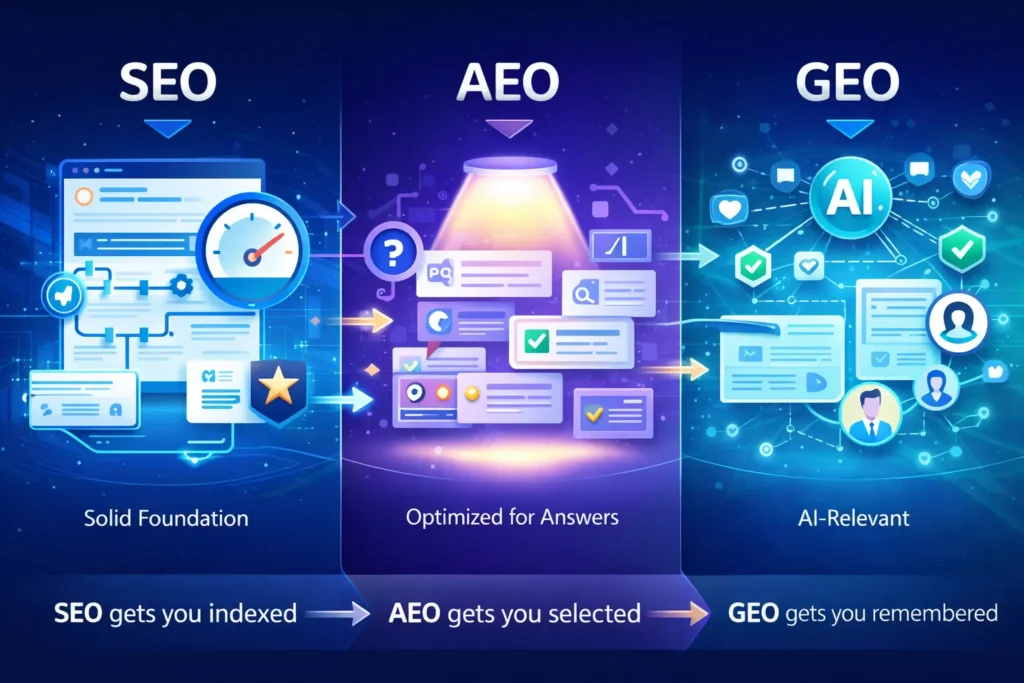
Step 1: SEO Builds the Foundation
- Optimized website
- Fast loading pages
- Strong internal linking
- Clear topical authority
Step 2: AEO Makes You the Answer
- Question-based headings
- Clear definitions
- FAQ sections
- Structured data
Step 3: GEO Makes You AI-Relevant
- In-depth content
- Entity mentions
- Natural language explanations
- Trustworthy sources and data
- Question-based headings
- Clear definitions
- FAQ sections
- Structured data
Step 3: GEO Makes You AI-Relevant
- In-depth content
- Entity mentions
- Natural language explanations
- Trustworthy sources and data
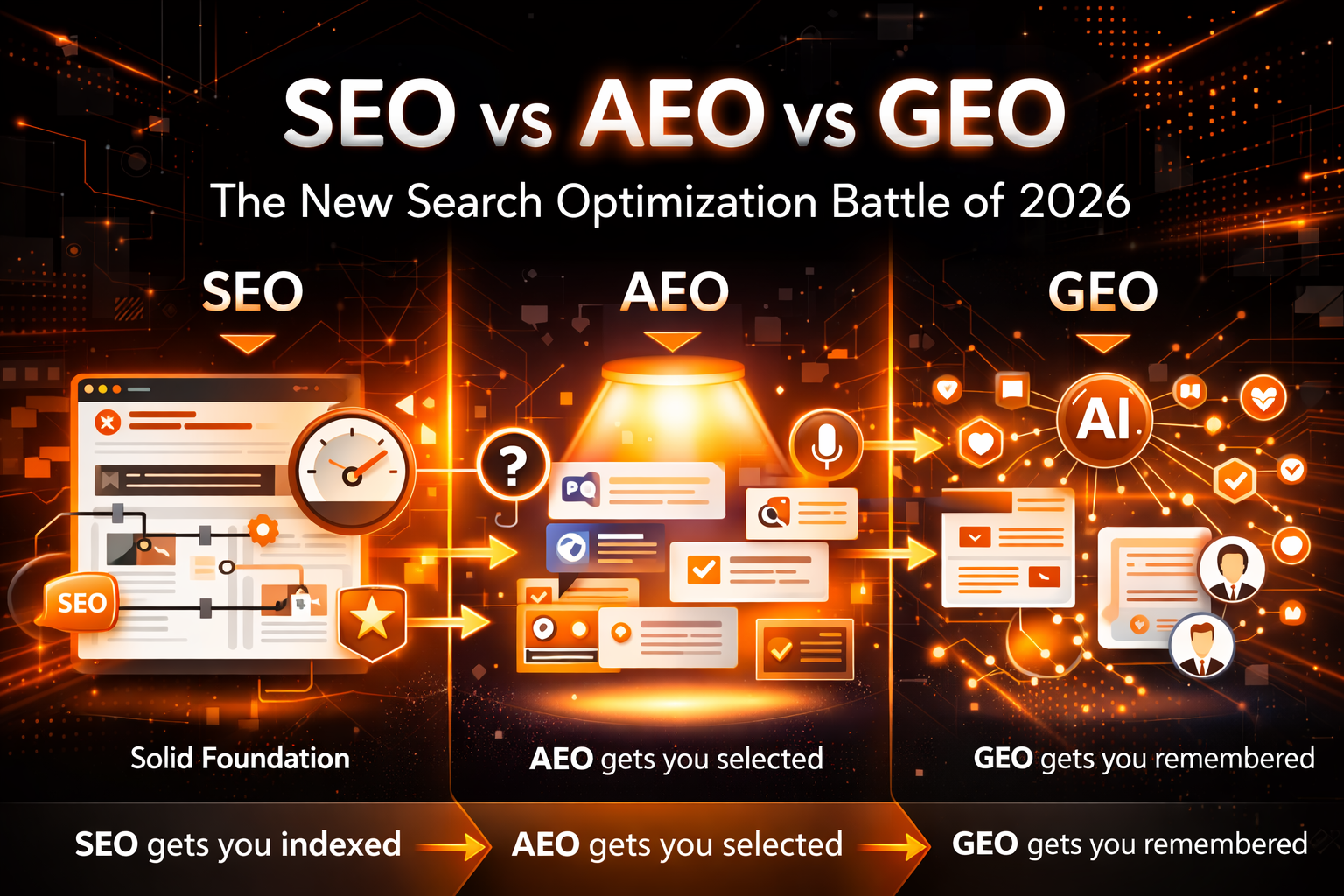
When combined: SEO gets you indexed, AEO gets you selected, GEO gets you remembered.
Content Strategy for SEO + AEO + GEO in 2026
To win the search battle, your content should:
- Answer real user questions
- Use conversational language
- Include FAQs
- Provide deep explanations
- Follow clear structure
- Use semantic keywords
- Focus on intent over keywords
- Demonstrate expertise and trust
Think less like a search engine optimizer and more like a knowledge provider.
FAQs: SEO vs AEO vs GEO
Conclusion: The Real Winner in 2026
The search optimization battle of 2026 is not about choosing SEO, AEO, or GEO.
The real winner is the brand that:
- Understands how users search today
- Delivers clear answers
- Builds deep authority
- Adapts to AI-driven discovery
SEO brings structure.
AEO brings clarity.
GEO brings future relevance.
In 2026 and beyond, success belongs to marketers who stop chasing rankings and start earning trust, answers, and AI visibility.
The future of search is not just optimized—it’s intelligent.